 Pouya Edits
EN
Shorts vs. Reels vs. TikTok: what actually changes per platform
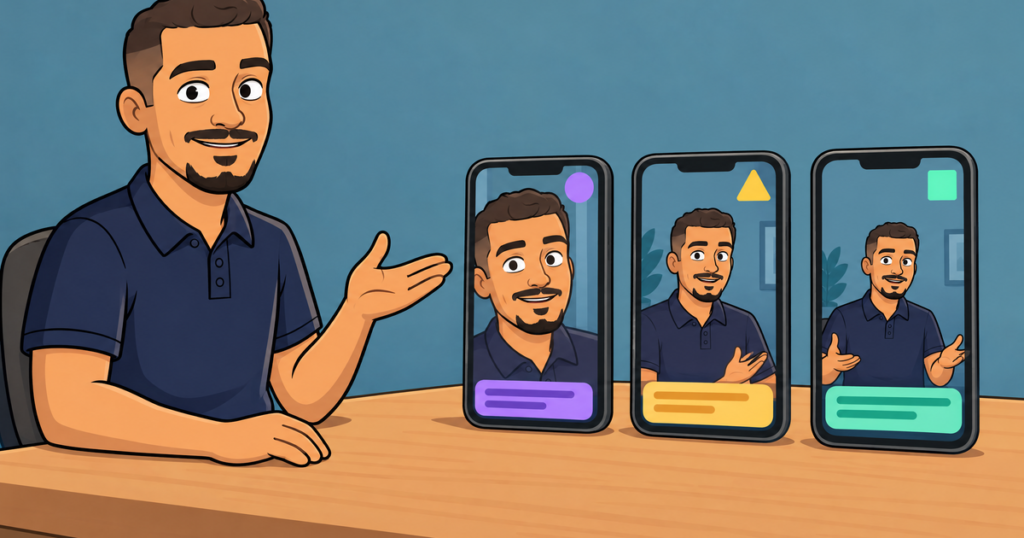
Platform-native formatting means more than just resizing to 9:16. Caption placement, safe zones, pacing, and hook length differ across each platform.
The same core clip should be repackaged, not just re-exported.
But the advice usually stops there, which leaves you guessing at what “repackaged” means in practice. Here is the specific list, and the myths worth ignoring.
What does not change
Start here, because it saves a lot of wasted effort: the clip, the hook and the edit are the same on all three. A moment that works on TikTok works on Shorts. There is no separate creative strategy per platform, and building one is how people end up spending five hours on three uploads.
What changes is the packaging layer around a shared master edit.
What genuinely changes
Safe zones
Each app draws its own interface over your video, and they cover different parts of the frame. TikTok’s right-hand rail and caption block eat the bottom third and the right edge. Instagram covers the bottom for Reels UI and, if anyone shares it to a story, the top as well. YouTube’s Shorts player takes the bottom and the right.
The practical rule: keep captions and any critical subject inside the middle band — roughly the central 60–70% vertically — and nothing that matters within about 15% of the right edge. One layout that satisfies all three is easier to maintain than three layouts, and costs almost nothing in composition.
Caption style
TikTok audiences expect word-by-word burned captions and read them as native. Instagram sits in the middle. YouTube Shorts tolerates cleaner, calmer captions, partly because a chunk of the audience arrives from long-form and reads the channel as a channel rather than a feed.
You can run one caption style everywhere and be fine. If you are optimising, the punchy end of the range costs you less on TikTok than the calm end costs you on Shorts.
Length tolerance
TikTok will carry a longer clip if the retention holds, and rewards a slower build more than the other two. Shorts is the least forgiving of a slow opening. Reels sits between them and punishes length more than either when the clip is weak.
In practice this means the same clip can go out at, say, 45 seconds on TikTok and 30 on Shorts, with the Shorts version losing the extra breath at the front rather than anything from the payoff.
Audio
Trending audio still carries real weight on TikTok and Reels and almost none on Shorts. For original-voice clips — which is most repurposed long-form — this mostly does not apply, and chasing sounds with talking-head footage is usually a waste. Where it matters is B-roll-led clips with no dialogue, which do measurably better on Reels with a current track under them.
Discovery behaviour
TikTok’s feed will push a clip to people with no connection to you, fastest of the three. Shorts leans harder on your existing channel signals and on search, which means a Short can keep earning views for months rather than dying in 48 hours. Reels sits closest to your follower graph and the Explore surface.
The consequence is a scheduling one: judge a TikTok in two days and a Short in two weeks. Deleting an underperforming Short after 24 hours is a mistake I see constantly.
Watermarks and re-uploads
Exporting from one app and uploading to another carries that app’s watermark, and every platform has an obvious reason to deprioritise it. Export the clean file from your editor and upload the same clean file to all three.
The myths
- “You need different content per platform.” You need different packaging. The content is the same.
- “Cross-posting is penalised.” Watermarked cross-posting is. A clean file uploaded natively three times is normal practice.
- “9:16 is the port.” Aspect ratio is the easiest 5% of the job and people treat it as the whole job.
- “Post at the optimal time.” On feed-driven platforms this matters far less than it did. Posting consistently beats posting cleverly.
The actual workflow
One master edit, captions inside the shared safe zone, then a per-platform pass that takes about a minute: trim the front for Shorts, adjust the caption line if you keep two styles, write the platform-appropriate description, upload the clean file.
That pass is a step inside the 40-minute weekly workflow, and it only works if the edit underneath it earns attention in the first place — which comes back to the hook.
Want results like this from your own long-form content?
Book a callMore from the Blog
A branded reel for A Star Barbers (around 1.3M followers on Instagram), Dubai to London for a Nike-backed event, cut to his team's voice-over. His first real post after a year of quiet, at around 45K views.
4 reels and 3 stories for a UAE luxury menswear store, planned off five reels that already worked, shot and edited in about four hours, and delivered editable in the client's own Premiere project.
Six family travel vlogs from one trip, usually back in 24 hours and never more than 48, while the client stayed on holiday. The Lebanon episodes averaged 1.9x his previous six.