 Pouya Edits
EN
How to choose which moments from a video become Shorts
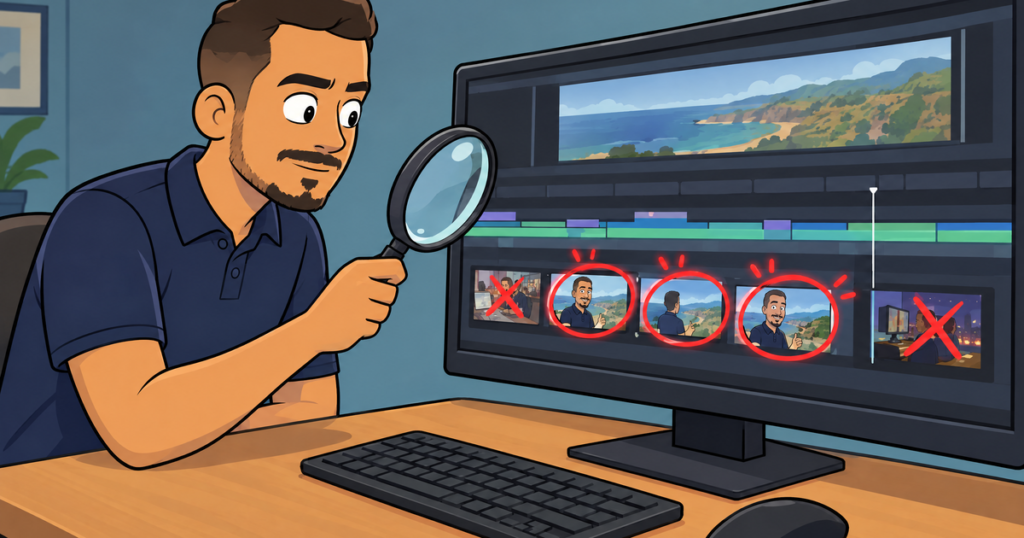
Most creators pick their Shorts by scrubbing the timeline until something feels good. That is why the clips end up competing with each other instead of covering different ground.
Selection is a separate job from editing, and it is the one that decides how far a clip travels. Here is the pass I run on a finished long-form video before a single cut is made.
The selection pass
Fifteen minutes of finished video should produce a log of five or six candidate moments, and roughly half of them should be cut. The ones you drop teach you more than the ones you keep. Three reasons to cut a candidate:
- It needs ninety seconds of context. Anything that cannot be set up in a single line of on-screen text is not a Short, it is a chapter.
- It is funny only if you know the person. Inside jokes travel to subscribers and die everywhere else, and short-form traffic is mostly strangers.
- It makes the same point as a stronger clip. Two clips making one point compete with each other; the weaker one absorbs the reach the better one should have had.
Make the survivors different in kind
The clips that make it through should not be three timestamps from the same video so much as three different types of clip. These three cover the most ground:
The result, up front
Take the strongest moment in the video — usually buried deep, after a long build — and open on the outcome, then rewind to how it happened. Reversing chronology is nearly always available and nearly always underused. This is the type a stranger can understand with no context at all, so it tends to reach the widest audience.
The disagreement
Look for a passing remark that cuts against the usual advice in your niche. In the long-form it is ten seconds of aside; on its own it can carry a whole clip, opening on the contradiction and spending the remaining twenty seconds justifying it.
Clips like this pull comments rather than pure watch time, and the comments are what keep them circulating.
The practical one
A specific, immediately usable step. No story, no reveal — a promise in the first line and delivery for the rest. This type has the lowest ceiling and the highest save rate, and it is the one most likely to send someone back to the channel.
Why three angles beat one clip cut three ways
Broad-appeal, opinion and practical clips get shown to different audiences. Three angles on one video is closer to three shots on goal than to three copies of one, which is the whole reason the selection pass is worth doing deliberately.
Cutting the same moment three ways is repetition. Cutting three moments three ways is coverage.
Packaging and posting
Use the same caption style and the same safe-zone layout across all three, so no per-clip design decisions are made. Each still needs a per-platform pass of about a minute — the details are in Shorts vs. Reels vs. TikTok.
Post them across a week rather than the same day. Clips posted together compete for the same slice of your audience’s attention; clips spread out do not, and the spacing gives you a read on which angle worked before you cut the next batch.
The short version
- Log more candidates than you will use, then cut ruthlessly — six logged, three made.
- Drop anything that needs more than one line of setup.
- Make the survivors different in kind, not just in timestamp: one broad, one opinionated, one useful.
- Reverse chronology whenever the payoff is buried.
- Space the posts out.
The mechanics of each opening are covered in the hook formula behind every 500K+ view Short, and the weekly version of this process is here. If you would rather test the approach on one of your own videos first, that is what a single Short is for.
Want results like this from your own long-form content?
Book a callMore from the Blog
Restructuring the first 3 seconds is the highest-leverage edit you can make.
A branded reel for A Star Barbers (around 1.3M followers on Instagram), Dubai to London for a Nike-backed event, cut to his team's voice-over. His first real post after a year of quiet, at around 45K views.
4 reels and 3 stories for a UAE luxury menswear store, planned off five reels that already worked, shot and edited in about four hours, and delivered editable in the client's own Premiere project.